
Nanofiltration
Selective water treatment at the water molecular scale
Nanofiltration delivers industrial water purification at the level where it matters: the physical separation of dissolved salts, organic matter and harmful ions. With pore sizes of just 1-2 nanometers, nanofiltration filters where conventional methods fail.
Energy-efficient and cost-effective
Nanofiltration operates at significantly lower pressure than full desalination. This means lower energy costs, reduced maintenance and a smaller ecological footprint, without compromising water quality.
From wastewater to reusable process water
Nanofiltration forms the ideal bridge between raw water treatment and ultrapure water. Industries use it as a pretreatment step, as a water softening stage, or directly for the reuse of process water in their production.
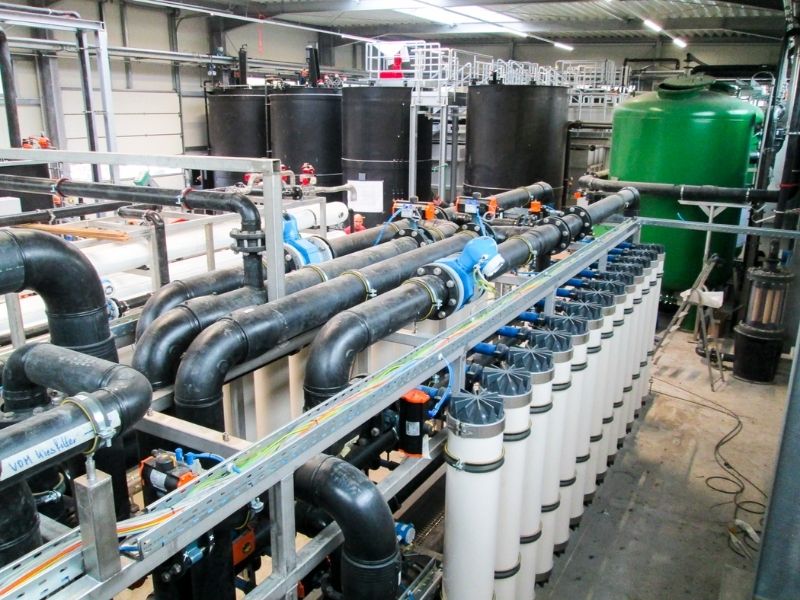
Benefits of Morselt Nanofiltration
- Selective ion separation: Against multivalent ions and organic matter, while allowing monovalent salts to pass through
- High energy efficiency: Low-pressure operation saves significantly on energy costs compared to reverse osmosis
- Reliable removal: Effective against calcium, magnesium, heavy metals, dyes, pesticides and PFAS
- Maximum reuse: Completely physical process without chemical additives, ideal for water that must be reused
- Flexible integration option: Combines easily with pretreatment (chemical precipitation, flocculation, plate settling)
- Hygienic water treatment: Retention of microorganisms and bacteria for clean process medium
- Durable membranes: Polymer or ceramic quality with high chemical and thermal resistance
Technical specifications (standard)
- Membrane type: Thin-film or ceramic membranes
- Pore size: 1-2 nanometers (molecular weight 200-1,000 Da)
- Operating principle: Physical sieving action combined with charge selectivity
- Operating pressure: Low to moderate (lower than reverse osmosis)
- Removed substances: Multivalent ions, organic compounds, PFAS, dyes, heavy metals, microorganisms
- Outlet water: Clear filtrate (permeate) and concentrated reject stream
- Material resistance: High temperature and chemical resistance against aggressive wastewater
- Capacity: Modularly scalable via compact racks
Configurations and options
Ultrafiltration as pretreatment
Ultrafiltration (UF) protects your nanofiltration membranes by removing suspended solids, turbidity-forming particles and bacteria from the water. Works with larger pore size (0.01-0.1 µm) and forms the ideal protection after flocculation or biological wastewater treatment.
Nanofiltration as main step
Nanofiltration (NF) works where finer filtration is needed: in the 1-2 nm range. Blocks dissolved organic matter, PFAS, multivalent ions and dyes, while keeping energy consumption significantly lower than full desalination. The choice for partial desalination and targeted water softening.
Reverse osmosis as polishing step
Reverse osmosis (RO) is the ultimate purification step for virtually complete desalination and ultrapure water. Works with finer membranes and uses higher pressure, but is unbeatable for maximum purity where extreme quality is required.

